


Kusina ng Pag-asa Program Launch
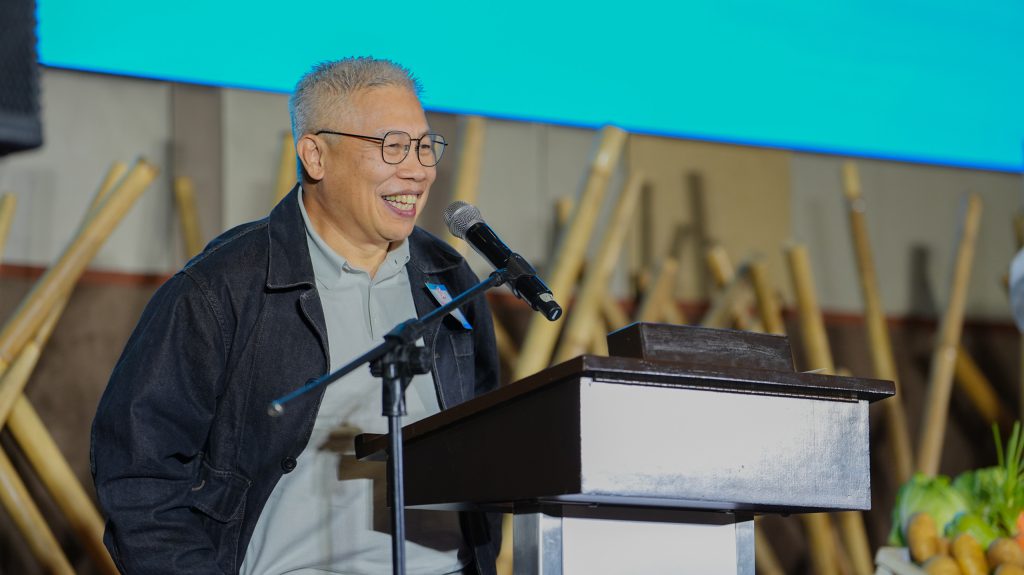
Rapa C. Lopa, President, ASA Philippines Foundation, Inc.
Magandang hapon po sa ating lahat.
To our partners in government, to our friends in the media, to the Angat Buhay family, to the Maginhawa Food Community and Dentrsu Creative Philippines teams, and to every kitchen owner, volunteer, and community member who said yes to this — maraming salamat po sa inyong pagdating. When I was first told about Kusina ng Pag-asa, my first reaction was simple: bakit hindi natin ito ginawa noon pa?
Because the idea is not complicated. It is, in fact, very Filipino. You prepare. You organize. You make sure the food is ready before the neighbors arrive. That is just good hosting — and in a country that faces as many disasters as ours, that same instinct to prepare, to anticipate, and to take care of one another should be at the very foundation of how we respond to emergencies.
As President of ASA Philippines Foundation, I have the privilege of working alongside over two million micro-entrepreneurs across this country — most of them women, nanays, lolas, many of them running the small carinderias and food stalls that are the lifeblood of their barangays. Being close to those communities has reinforced for me something that development data consistently shows: that the populations most exposed to disaster risk are also the ones with the least capacity to absorb its impact. They have fewer buffers. They recover more slowly. And the consequences of a delayed or inadequate response fall heaviest on them.
This is not an abstraction. It is the lived reality of millions of Filipino families. And it is the reality that Kusina ng Pag-asa is designed to address — not with temporary measures, but with a structured, scalable, and sustainable system that holds even under pressure.
As ASA Philippines embraces its new mission to provide vulnerable families with access to resources and services that lead to self sufficiency, we see Kusina ng Pag-asa as a vital extension of that goal. We believe in our brand purpose: Palaguin ang Pag-asa. We don’t just want to provide a meal; we want to help grow a community’s capacity to stand back up on its own. By empowering the carinderias and food stalls – many of which are run by the women microentrepreneurs we serve – we are ensuring that hope doesn’t just arrive; it stays and it grows.
The question we must always ask in development work is not just whether we are helping — but whether the help is arriving fast enough, safely enough, and with enough dignity to actually make a difference. Kusina ng Pag-asa is built precisely around that question.
At the core of this program is something Angat Buhay has always believed: “Tutulong na rin lang, tumulong na nang maayos.” If you are going to help, help well.
This is what makes Kusina ng Pag-asa sustainable in a way that most relief programs are not. It does not depend entirely on external funding that may or may not arrive in time. It builds its own resource base — continuously, community by community, kitchen by kitchen — so that the operational fund is always growing, always available, and always ready to be deployed wherever it is needed most across the Philippines.
br> That is why we have brought together like-minded organizations and corporate partners in this room today. Not for a one-time donation, but for a long-term investment in an ecosystem that generates its own momentum. Your support today helps us build the infrastructure that keeps this network alive and functioning — the training programs, the operational systems, the quality standards — so that the kitchens can do what they do best: feed people, build solidarity, and sustain the mission even in the spaces between emergencies.
I also want to take a moment to speak about what this program means for the food enterprises at its center — because I think this is one of the most important and often overlooked dimensions of the model.
The carinderias, the small restaurants, the community kitchens joining this network are not being treated as vendors to be tapped in a crisis and set aside when the crisis is over. They are genuine partners — with formal agreements, fair and transparent compensation, and a clearly defined role in both the disaster response and the resource generation work of the program. Their participation protects their livelihoods. Their inclusion in the training and capacity-building process strengthens their operations. And their role as resource generation hubs gives them a stake in the mission that extends well beyond any single activation. This is what it looks like to build a humanitarian response system that is genuinely rooted in the community. Not imposed from the outside, but grown from within — with local enterprises as the backbone, local volunteers as the hands, and local knowledge as the guide.
In development terms, we call this community ownership. In Filipino terms, we call it bayanihan. And Kusina ng Pag-asa, at its best, is both. Let me close with something simple.
In the middle of a disaster, a warm, safe, properly prepared meal is not a luxury. It is a lifeline. But more than that — it is a message. It tells a family in an evacuation center, uncertain and afraid: hindi kayo nakalimutan. You were not forgotten. Someone thought of you before the flood came. Someone organized, prepared, invested, and made sure that when you needed to be fed, the food was already on its way.
That is the country we are trying to build. Not one that merely reacts to suffering, but one that prepares for it — with humility, with discipline, and with the unwavering conviction that every Filipino, in their most difficult moment, deserves to be treated with dignity. Kusina ng Pag-asa is a step in that direction. A meaningful, well-designed, and community-rooted step. And I am genuinely honored to be part of building it.
Maraming salamat po.